Paris - Colombia
Solukhumbu- Nepal
Chialsa Homestay
Architectural project & reserch
2022
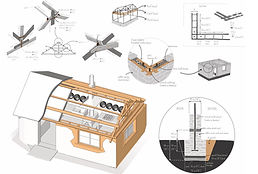
This project is located in the Solukhumbu region, south of Everest, in a rural Himalayan context, approximately 200 km and a 10-hour journey from Kathmandu. Situated at 2,240 meters above sea level, the site is exposed to significant seismic risk as well as potential flooding and extreme mountain climate conditions.
The project consisted of the design, reconfiguration, and renovation of the birthplace of the co-founder of the association in Nepal, transforming it into a guesthouse for volunteers, trekkers, and visitors interested in Tibetan Buddhist spirituality, as well as in local agricultural practices. In this remote mountainous area, access to transport and construction resources is extremely limited, requiring the use of local materials and a deep understanding of traditional building typologies.
The design had to address seismic safety principles, seasonal heavy rains, snowstorms, and local post-earthquake construction guidelines. Beyond the technical aspects, the project aimed to generate economic income to support children sponsored by the association in Kathmandu, strengthen agricultural production, and create local opportunities while offering visitors an immersion into rural Himalayan life.
From this experience in the mountains, I came to understand that projects are above all collective learning processes, and that the role of the architect is also one of mediation. It led me to question my own position as an architect, the need to step away from ego and preconceived ideas, and the importance of truly inhabiting and sharing the place in order to understand it. This experience also revealed broader dynamics of rural-to-urban migration, patterns that repeat across many contexts worldwide, as well as the deep intelligence embedded in vernacular architectures and their memory of risk — often more enduring than collective human memory itself.
Looking back, I recognize that many aspects could have been improved. More than a finalized project, what remains is a set of documents that may or may not eventually be built. Many construction details still need to be resolved on site; what we can offer is clarity, pedagogy, and adaptability in the way the project is represented. The intention was to translate into architecture the seismic guidelines and knowledge we had studied, hoping that the building process itself could become a form of learning. We proposed a phased construction, aligned with fundraising and local capacities.